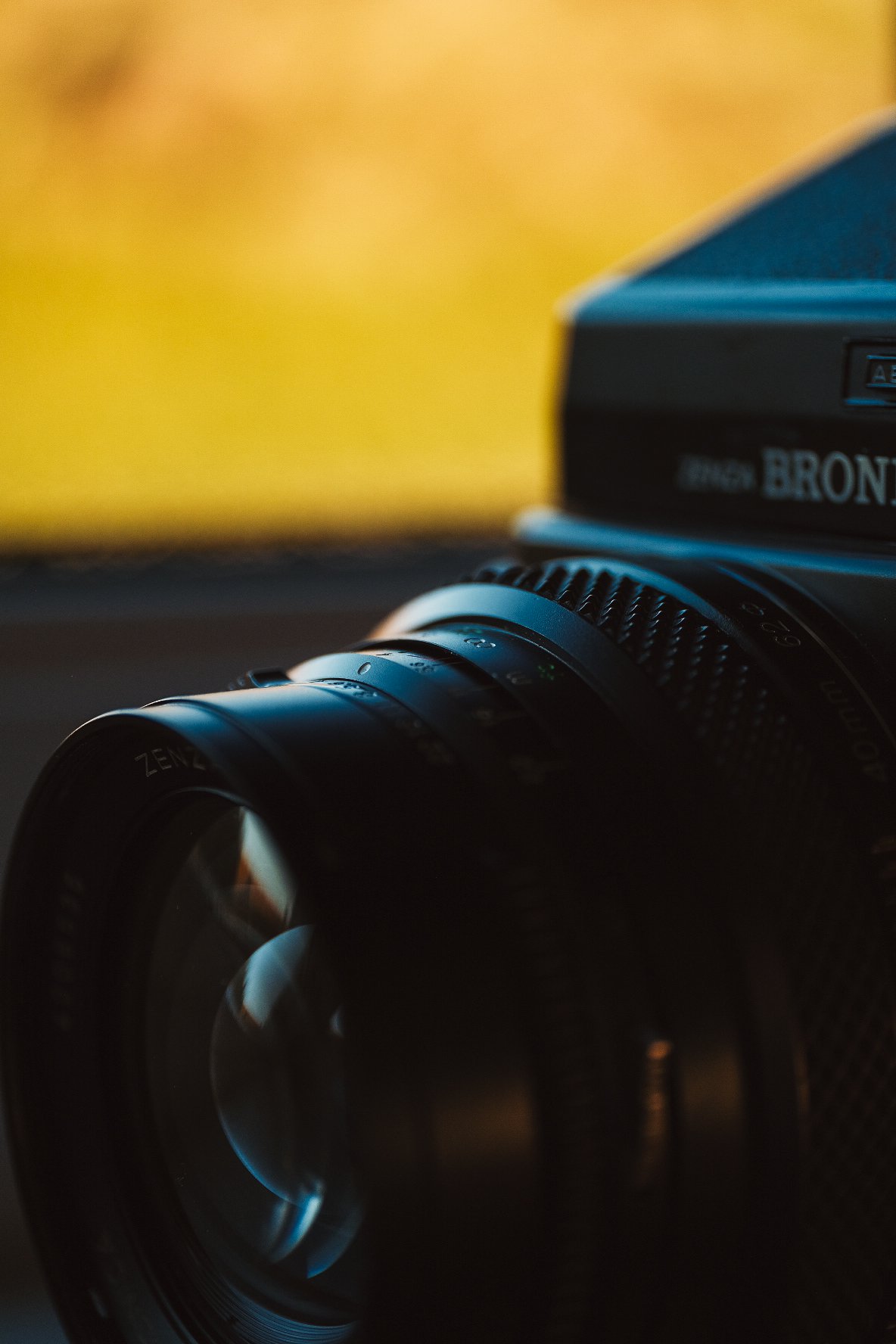
One of the most fun aspects of choosing the Bronica eco-system has been the discovery of, and working out, all the parts that can go into this modular setup. It’s a quite fantastic array of things you can do to make the ETRSi fit whatever style or task you may have.
Ultimately it’s a central cube around which you bolt on stuff - lenses, film backs, prisms, viewfinders and grips. From the very simplest setup of a 75mm lens with a 120 film back, hand-crank and waist-level-finder (WLF), allowing minimal transport and handling cost, to a fully built up 150mm telephoto setup with speed grip, AE-II prism finder and multiple film backs, this wee Bronica can do everything.
It’s not just the external bits either. There’s focusing screen options, prism diopter strengths and little tweaks that can make this camera work for you. For those seeking the simplicity of modern digital cameras, where all this is built-in to the system already (like diopters for failing eyeballs), the Bronica forces you to do some fact finding and research to make it work for your individual setup.
I’m having to seek out a part that is woefully rare - an eye correction lens of +1.5 strength to fit the ETR eyepiece. A diopter adjustment, in other words. The WLF is easy to find a +1.5 adjuster, but for the AE-II prism finder, it’s either importing a part from Japan at many tens of pounds, if not hundreds if customs take a liking to it, or what I’m attempting to do - find a +1.5 diopter and cut/file/sand/manipulate to shape. I’m also about to visit the opticians for my 3 yearly appointment, and I’m tempted to ask if they can get involved…
I also love to shoot wide open whenever possible, to really lean into the lens characteristics and quirks of optical glass. Sure, stopping down to f/8 for maximum sharpness resolution is cool, bro, but I want isolation, separation of subject from other stuff. This want has highlighted another quirk of the ETRSi system, in that the leaf-shutter embedded in each lens limits the shutter speed of this entire system to 1/500s. Given the wide aperture of f/2.8 on the 75mm, this has had me working out how I can go about photographing things at the widest aperture for each lens, in a myriad of lighting conditions from full mid-day sunshine to overcast misty days, dark whisky warehouses and general interior fam shots.
The fact it’s film means this question has had lots of answers. 120 film comes in many different options, mostly based on the speed of it. When I think back to my GFX days, I was always shooting around ISO50/100, which the GFX handled most times with it’s artificial push to ISO50. That was on a 55mm f/1.7 lens mind you, so no wonder.
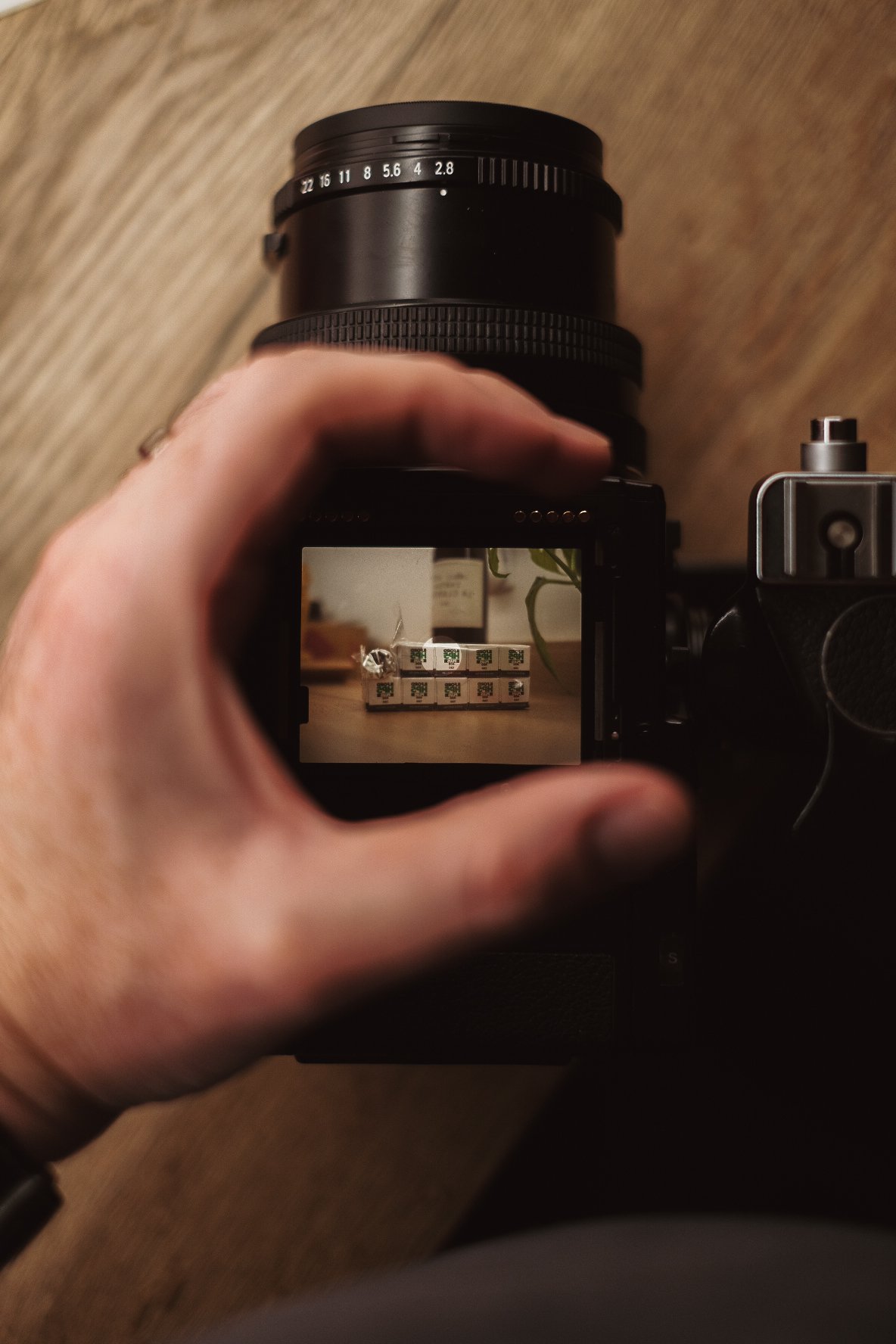
I’ve been using, for the first time in my life, AI tools (through Google, who force you to use them anyway, so it’s not by choice) to understand how I go about making the ETRSi system work for what I need - wide open shooting. The results have been astonishingly quick and extremely helpful. The power of AI when it comes to learning, has blown me away. I am utterly anti-AI when it comes to the creative field and creation of art in any facet, but for working out how to do something within a set of parameters, it’s crazy good. Conversational too, which flummoxed me a wee bit. Taking the “conversation” we’ve had and referring back to it each time I add a question or ask for clarification. It’s really quite cool.
As such I now have a really comprehensive guide to using this Bronica ETRSi setup with the film stocks I’ve chosen to use, with development times for the negatives and subsequent scanning to digital files using my Fuji X-T4. The AI search knows no bounds, taking its answers from everywhere, from Reddit to forums, websites to Ilford’s own technical PDF documents. It’s unbelievably powerful, and also destructive. I would have spent weeks trawling through forums and websites to find out the information I held in my hand (for I printed it obviously) in minutes. I wonder how many more years people will post on forums, or websites, or Reddit. Soon we’ll just bash it into AI and it’ll spit out the answers. Until those websites disappear and AI ends up referencing it’s own answers, and then we’re all fucked.
Anyway. Here’s “my” guide. I even had it make me business card sized wee reference guides that I could print out and laminate, because I’m archaic. Looks like I need to get a couple of other things - an Orange filter to boost blue skies and cut ¾ stop of light, as well as an ND4 (1-stop filter) to remove another wee bit - just for flexibility in the rapidly changeable Skye weather system.
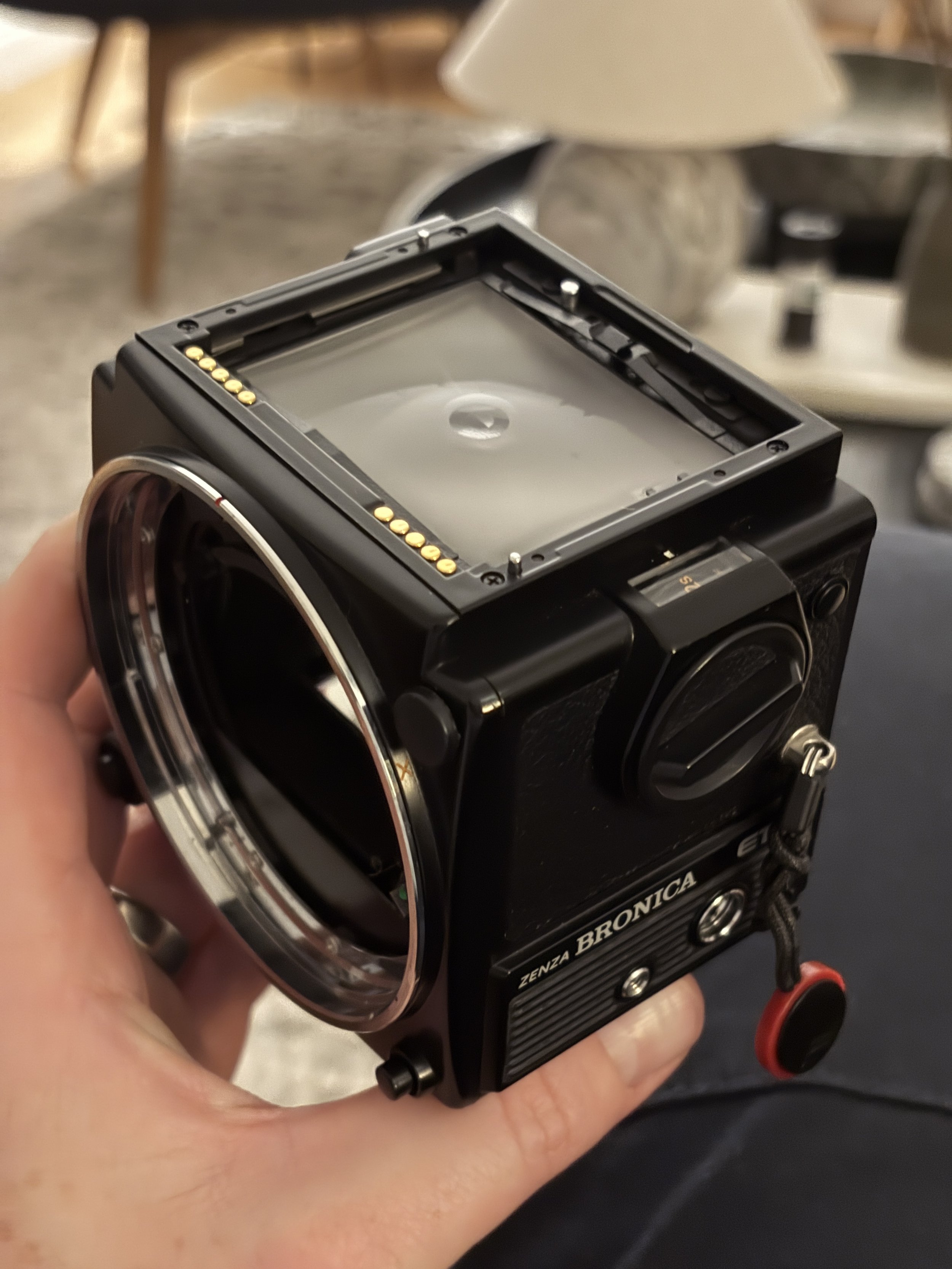
The Cube
I guess you could call this the central processing unit…
Mirror, focusing screen, attachment for the sensor, attachment for the lens, attachment for the crank.
I’ve seen pictures of the ETR system with its sides off, exposing the mechanical marvel underneath. This is incredible tech - albeit intrinsically tied to electronics, given the shutter is powered by battery until 1/500s, whereby, even if there’s a battery outage, it’ll still fire at 1/500s.
Redundancy.
In the meantime I’ve been ordering loads of things through eBay auctions and best offer boldness to get this system up to speed such that I can start to shoot some film, develop it here at home and then scan it to digital files for uploading on the website. Gone are the days of ordering a digital body and a lens and snapping away. It’s been an education, mostly in the film stocks available, what their temperament is in terms of robustness and demands for processing (like PAN F, which needs to be processed almost the same day to avoid degradation of the exposed film. Whether there’s credence in this I don’t know, especially for hobbyists like me, but I’m not willing to find out).
Here’s the current setup:
Zenza Bronica ETRSi Body with horizontal split prism and micro-prism ring focusing screen.
Zenzanon PE 75mm f/2.8 (I predict this will be my main lens)
Zenzanon MC 40mm f/4 (Came with the body)
Zenzanon MC 150mm f/3.5 (I won this on eBay for £56!)
120 Film back (x2)
Speed Grip E
AE-II Prism Finder with custom bodged +1.5 Eye Correction
WLF with +1.5 Eye Correction
4LR44 batteries (which turns out is just 4 button batteries welded together…hence the 4 in the 4LR44)Film stocks:
Ilford - HP5+, PAN F+, Delta 3200
Kentmere - PAN 100
Foma - Fomapan 100 ClassicDevelopment / Chemistry:
Ilford: Ilfosol 3, Ilfostop and Fixer
Kodak: Photo-flo wetting agent
Paterson tank/kit for development (measuring flasks, thermometer etc)
Lobster Holder v2.1 full kit (including lightbox, 645 plate and 35mm plate with sprockets)
Fujifilm X-T4 with Zeiss Touit 50mm Macro lens
Cobbled together “copy stand” with SmallRig magic arm and Manfrotto 405 Geared Head.I can’t bring myself to tackle colour film just yet - I’ll get the black and white situ locked in and comfortable with its nuances in the developmental phase, and then increase my boldness to attack the C41 colour film processing…process.
I’m waiting on all the chemistry arriving before I start shooting on PAN F, but I’ve been snapping away using the HP5+ so far, just to get a feel for how the camera operates and what it feels like to load, shoot and store film stocks. Such a beautifully mechanical experience it is too, with the reassuring clunk and ratchet clicks from the shutter and film-advancement. It’s not just taking photos and looking at them on the camera or on the computer. The process is now a lot more involved, including understanding the how of everything - how do I load 120 film onto a cassette in pitch darkness? How do I make sure I process the film correctly at the right temperature, and what happens if I miss marks or temp guidelines? How do I meter correctly? How do I time the various phases of development chemicals? Can I use regular pristine Scottish water or do I need de-ionised water?
I’ve also been trying to wrap my head around the concept of pulling and pushing film stocks/development times to achieve different results. With the AE-II Prism Finder it’s really easy to adjust the dial on the left side to “trick” the film into a different sensitivity, and thus working through what it means to push film in order to achieve a more balanced, more beautifully exposed frame. It’s not easy to get up to speed, but I’m hoping by the 2nd or 3rd roll I’ll be in the ballpark.
On top of that I’ve been looking at something called a Brightscreen, which is a focusing screen that’s a lot brighter, visually, than the stock standard Bronica screen. There’s trade-offs it seems - either through focusing/DOF visual clarity, or with metering for the AE-II prism (given that it meters TTL, so thus a brighter focusing screen means a compensating amount needs to be dialled into the metering prism permanently, on top of all the other metering adjustments needed for pushing, pulling, filter attachment and whatever the fack is happening in front of the lens). The current screen is quite dark, but I’ll make do for now. Loads to understand and adapt to on the fly!
What is clear though, even now at this very early stage, is how much slower, more deliberate and considered my movements have been. I’m questioning everything - do I want to take this photo? How am I metering it? Shoot for shadows, develop for highlights? Push or Pull? Composition, leading lines, framing, movement, motion, balance. Shutter speeds and hand-holding. Colour filters for black and white film. It’s all necessary and vital information required to achieve results that, I hope, will excite me and surprise me. If I have done all this and develop roll after roll of absolute mince, then it’s on me.